Founder market thesis
A practical 20/40/60 lens on route maintenance, home repair, and renovation—and why productized repair services can reconnect buyers with skilled local pros.
By Boots & Ladders · · 6 min read
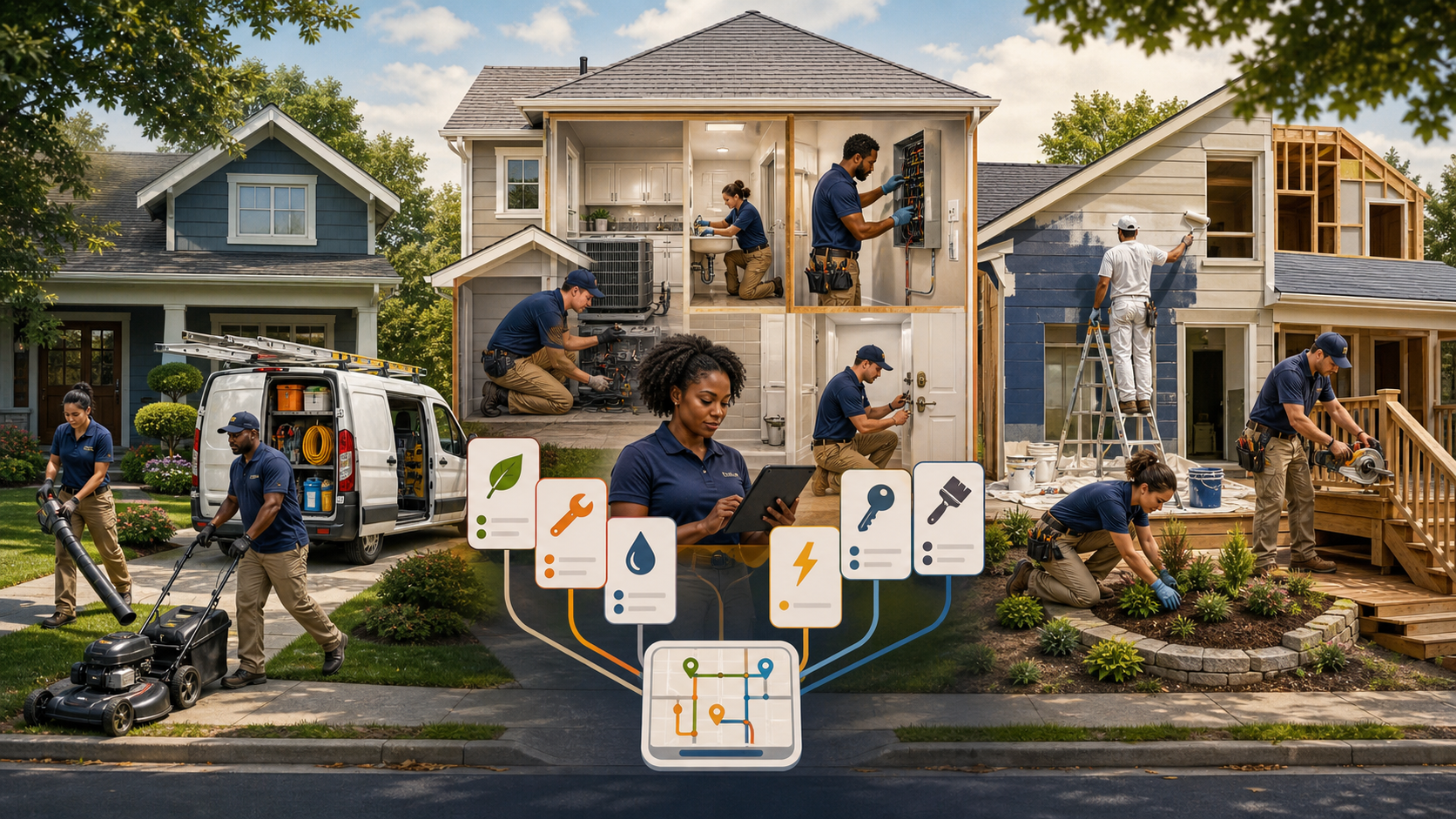
A 20/40/60 operating lens—not a market-share calculation
One useful way to understand the home-service industry is to view it through three overlapping opportunity bands: roughly 20% route-based maintenance, 40% repair, and 60% renovation. These figures are a strategic lens rather than exclusive market shares, so they intentionally overlap and should not be added together.
The framework helps explain why the two ends of the market are becoming easier to systemize while the middle remains fragmented.
The 20% band: route-based maintenance
Cleaning, lawn care, landscaping, gutter service, pressure washing, seasonal maintenance, and similar tasks are naturally repeatable. The scope is visible, the cadence can be scheduled, and jobs can be grouped by neighborhood or route.
CRM and field-service software work well here because the business can standardize checklists, recurring schedules, customer reminders, crew assignments, and follow-up. That consistency helps small companies retain employees, build predictable days, and grow recurring revenue.
The 60% band: planned renovation
Renovation is broader, but much of the volume can still be organized around familiar scopes: painting, modest additions, yard improvements, decks, flooring, kitchens, bathrooms, and exterior upgrades.
The work may require estimates and project planning, yet it follows a recognizable sequence. A CRM can manage opportunities, selections, milestones, change orders, crews, and customer communication. Once the company chooses the projects it performs best, repeatable systems make training and employee retention easier.
The 40% repair middle has been pulled in every direction
HVAC failures, plumbing leaks, electrical problems, locks, fixtures, appliances, and small household repairs sit between recurring maintenance and planned construction. Buyers often cannot describe the exact failure, while pros do not know the full scope until they arrive.
After the Yellow Pages faded, the average service professional lost a dependable local signal. The replacement was a noisy mix of lead-generation platforms, paid ads, search optimization, directories, and social-media feeds. Skilled workers were pushed into chasing attention, buying the same leads as competitors, and answering posts scattered across hundreds of channels.
Many software products followed that market in the wrong direction. They optimized lead capture, sales pipelines, and advertising activity instead of making the repair itself clearer and easier to buy.
Productizing repair reconnects the buyer and the pro
Common repairs can be turned into clear service offers with a defined starting scope, transparent price or diagnostic fee, service area, availability, likely materials, and expected result. The buyer gets a useful choice instead of a list of companies to call. The pro receives a structured work request instead of another unqualified lead.
Boots & Ladders reverses the traditional work order: the service offer comes first, and the buyer adds the property details, symptoms, photos, timing, and location needed to complete the match. AI can help interpret intent, but the transaction remains grounded in a real service, a real professional, and a shared expectation.
Saving the idle workflow
The opportunity is bigger than saving a few clicks. When productized services reduce repeated calls, unpaid estimates, cold-lead follow-up, manual scheduling, and invoicing friction, more than 60% of the unproductive workflow around a common repair can be removed in the right use case.
Buyers win through faster answers, clearer pricing, and better expectations. Sellers win through fewer dead-end conversations, denser schedules, more productive employees, and direct relationships with serious customers.
Maintenance and renovation already show what happens when work becomes systematic. Boots & Ladders is bringing that same structure to the repair middle—so skilled pros can get their zing back and local service can work for both sides again.
Keep reading
Why Voice AI Is the Next Interface for Local Service Marketplaces
How conversational voice search can reduce friction between a buyer’s spoken request and a clear, ready-to-request local service offer.
· 5 min read
From Idea to MVP: A Practical Guide for Founders
A practical founder guide to validating the problem, testing the message, launching a focused MVP, and learning directly from early users.
· 4 min read
The Future of Repair & Maintenance Is Route-Based, Productized, and Effortless
A practical model for moving repair and maintenance away from estimate-heavy sales loops and toward routed, fixed-scope execution.
· 2 min read
Productized Services, Ready to Go
How Boots & Ladders turns local services into simple, clear offers buyers can understand and request quickly.
· 4 min read