Three listing questions, answered
Your name, a clear price and an honest image help buyers understand your service. Three listing questions answered through Carlos’s $500 washing offer.
By Omar Kharbat · · 5 min read
Updated
What makes a service listing easier to choose?
Show who is behind the service, explain exactly what the price buys, and use an image that truthfully represents the offer. Your profile photo introduces the person. Your service cover explains the work. Your scope and price set the expectation. Those are three different jobs.
If you were hiring someone to work on your home, would you rather start with a mystery price and a logo—or a recognizable pro and a clearly described offer? That is the buyer's question I want service providers to keep in mind.
1. Why does my own name matter if I have a business name?
Your business name matters. So does knowing who the buyer is actually dealing with. Boots & Ladders is built around a direct connection with the pro behind the service—not simply another anonymous company listing.
A business name and the person behind it are not competing identities. Keep your business details accurate, but make it clear who is responsible for the offer and who the buyer will be talking to. If you have a concern about how your name appears publicly, ask support to review your profile; do not assume that a logo or business name makes the person behind the service irrelevant.
My recommendation is simple: make the person responsible for the offer easy to recognize. Use a clear, current photo of yourself for your profile, and describe your business accurately. A logo can support your brand, but it cannot introduce the person a buyer will be talking to.
A recognizable profile is a starting point, not a substitute for checking the experience, qualifications and terms relevant to a job. You do not need to publish private documents or a home address to introduce yourself professionally.
2. My service varies. How can I give it a set price?
You do not have to put every possible job into one fixed price. Start with a repeatable version of the service that you can describe and deliver reliably. Set a real price for that defined package, with clear limits and exclusions.
A house wash is not automatically the same job at every property. Size, height, surfaces, condition, access and the areas included can change the work. Decide which jobs fit your package; if a request does not fit, explain the different scope or assessment needed before agreeing to it.
Do not use a low headline price to bring someone in and then reveal unavoidable additions. Nor should you promise that a fixed package covers unlimited surprises. A useful offer answers: what is included, what is excluded, which properties qualify, what the customer must provide, and what needs confirmation before the visit.
If the work genuinely cannot be defined yet, be honest about the next step. An assessment with its own clear scope and price can be an offer too. Do not invent a fixed total simply to fill a price field.
Carlos’s $500 offer: a concrete place to start
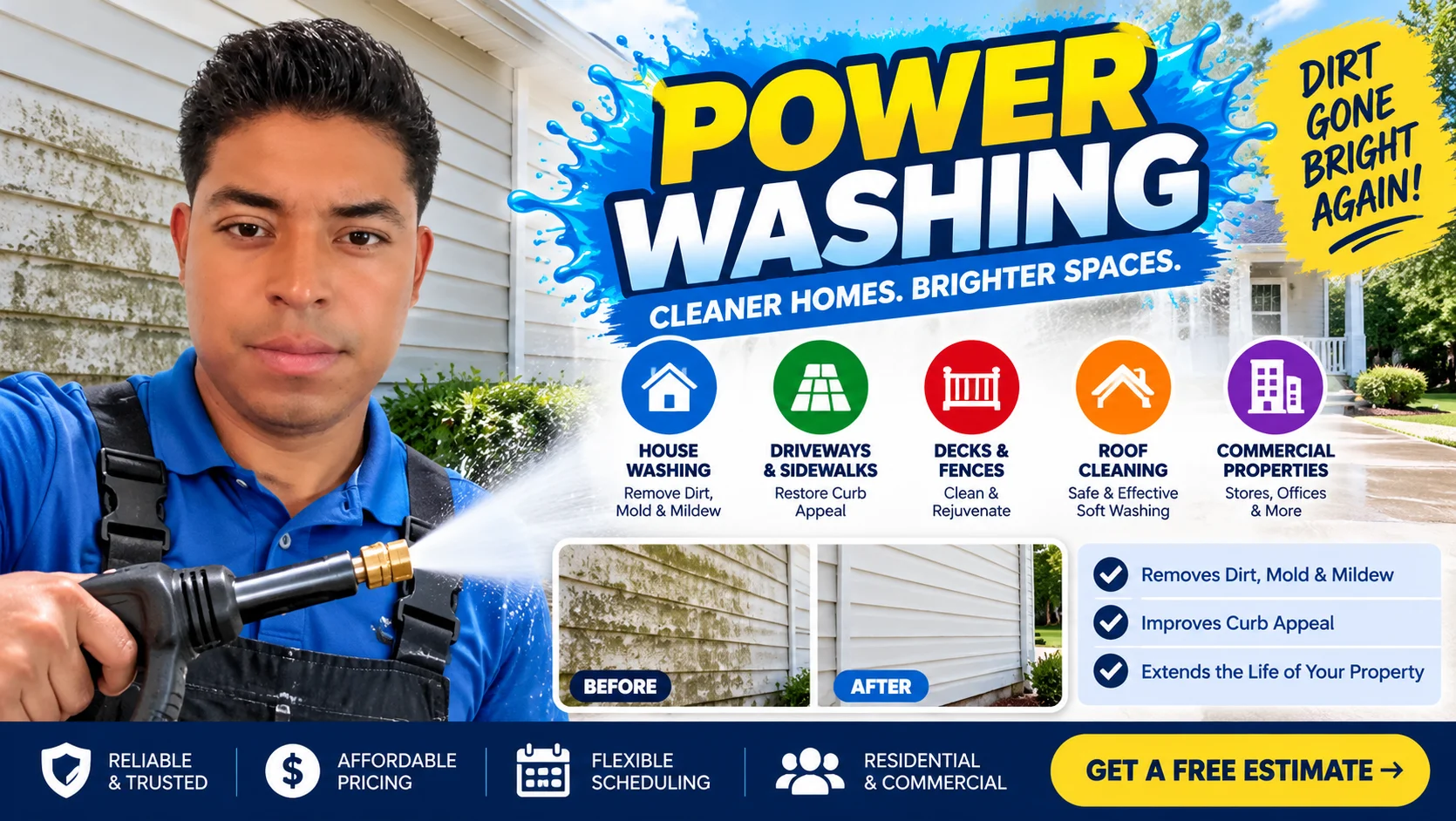
Carlos Bucheli has a Wilmington listing titled “Pressure Washing – House, Driveway & Exterior Cleaning,” displayed at $500 flat rate. His name and portrait are visible. A buyer can see the kind of work and the advertised price before opening a conversation.
Here is the package-building logic from the example I shared: take a usual $300 clean and combine it with $200 for commonly requested additional areas, such as a driveway and sidewalks. Instead of selling a basic clean and introducing those extras later, describe one $500 package from the start. That is an illustrative breakdown, not a standard price for every property.
The useful shift is to decide what belongs in the offer before the buyer has to ask for each addition. Rather than treating a driveway as a surprise upsell after the buyer has committed, make the included areas and package price explicit from the start.
The current listing names exterior cleaning, soft washing of siding, concrete cleaning, equipment and materials, and cleanup among its inclusions. It excludes interior cleaning, painting or repairs, heavy restoration or damage repair, and unavailable water or power supply. Buyers should read the current listing and confirm that their property and selected areas fit; the card alone does not establish a universal property-size allowance.
For any similar package, make the eligible area or size, access requirements and other limits easy to find. Buyers still need to confirm that their property fits the listed offer. Carlos has given them something concrete to consider before that conversation starts.
3. Should I use an AI cover, a logo or a real photo?
Separate the profile image from the service cover. For your profile, use a clear photo of the actual pro. For the service cover, a truthful photo of your own relevant work is a strong starting point. A readable service-specific design can also help explain the offer.
Carlos's cover combines his portrait with prominent power-washing graphics. You can tell what category of service the offer is about. Whether you use a design tool, AI or a designer, the important question is what the finished image communicates—not which tool made it.
Graphics should explain, not manufacture evidence. Do not present an AI-generated property, invented before-and-after result, borrowed customer photo or unsupported badge as proof of your work. Use only images you have permission to use, and clearly identify illustrations where a buyer could mistake them for real job photographs.
A logo can appear as supporting branding. It should not have to carry the whole explanation. Equally, a dramatic AI cover cannot replace a clear scope, a real price for the eligible work, or an accurate profile.
Check the words inside the artwork too. A generic “Get a free estimate” banner can send a different message from a $500 fixed package. Make the cover's call to action, service description and written offer agree. Graphics showing roofs, decks or commercial properties do not by themselves make those services part of the advertised package.
A useful offer starts the conversation further along
A buyer should not have to ask who you are, whether you serve the area, what kind of work you mean, and whether a price exists before deciding whether to contact you. Put those basics into the listing.
Then use the direct request-and-message conversation to confirm the remaining property details, fit and timing. A service request is not the same as a confirmed appointment, and an attractive card is not a substitute for agreeing the actual job.
In Grand Opening, I wrote about clearly defined expectations in regular service arrangements. The tools and channels change; that lesson still applies. The point of productizing a service is to make the promise easier to understand—not to pretend that skilled work has no variables.
Try this before you publish your next offer
Read your listing as a buyer. Can you identify the pro? Can you describe the included result in one sentence? Do you know the price for an eligible job, the limits, and what is not included? Does the image support that same promise without implying unverified results?
From the Boots & Ladders homepage, use Add Service to start shaping your offer. Review any generated text against what you can actually do. You, not the generator, are responsible for the final scope, price, image and availability.
Good job making the offer visible, Carlos. A recognizable person, a service-specific cover and a stated package price give a serious buyer something concrete to consider. The next step is a focused conversation about whether that particular job fits.
Boots & Ladders is a direct local marketplace helping independent pros offer services people can understand and request directly. Powered by the community. Fueled by the pros. Built to keep the pro and the buyer in the conversation.
A note about this example
These three questions come from conversations with Boots & Ladders users. Carlos’s $500 flat-rate listing was checked November 21, 2026; offers can change. The pricing breakdown above is the founder's illustrative example. The cover is shown as promotional listing artwork, not as independently verified before-and-after job evidence.
See Original source for Carlos's current offer and Keep reading for related guides.
Carlos Bucheli’s $500 flat-rate pressure-washing listing; checked November 21, 2026
Keep reading
People buy services from people. Not Logos
So if you haven’t looked lately, check out the local pros putting their own names behind their work—with upfront pricing, transparent profiles, and services ready to buy.
· 5 min read
You Didn’t Learn a Trade to Spend Your Life Selling Yourself
Clear service offers help independent specialists explain scope, pricing, and expectations. A practical approach to making skilled work easier to hire.
· 5 min read
How Service Pros Can Stop Free Add-Ons Without Losing the Customer
A practical guide for service professionals to prevent unpaid add-on work with clear inclusions, exclusions, pricing, and customer-friendly scripts.
· 6 min read